Thomas and Ann Askew
When I was gathering data on James Goddard and Mary Askew, I noted that the names of the witnesses at their wedding in January 1853 were Thomas Askew and Ann Siddall. It seemed likely that Thomas Askew was Mary Askew's younger half- brother, who accompanied her on the voyage to Australia on the "Sir Robert Sale", but I was unsure about Ann Siddall. Subsequent research established that she was Ann Askew, Mary Askew's half-sister who had married William Siddall in Derbyshire and emigrated to Australia in time for Mary's wedding. I was equally intrigued that George Culliford, named as the informant at the time of James Goddard's death in 1860, was described as the brother-in law of James Goddard. Again, research showed that he had married Ann Askew/Siddall after the death of Ann's first husband. This page provides details of this and other information on Thomas and Ann Askew.
Thomas Askew (~1831->October 1887)
Thomas Askew, the half-brother of Mary Askew, was born in Higham Derbyshire, the first son of Thomas Askew, the village blacksmith, and his second wife Elizabeth. Like his father, Thomas Askew was a blacksmith.
On 5 July 1852, Thomas Askew arrived at Point Henry, Geelong on the "Sir Robert Sale" with his older half-sister Mary Askew . He went ashore of his own accord to take a position as a blacksmith at Little Malop Street, Geelong. Little is known of his life in the Geelong district for the next few years, although it is believed that he was the Thomas Askew listed as a witness at the marriage of Mary Askew to James Goddard at Christ Church, Geelong on 6 January 1853.
An Early Settler in the Smeaton District
In his book "Early Creswick", John A. Graham (1942) describes the release and sale of land in the Creswick district of Victoria, and in particular the acquisition of land on the fertile basalt-derived soil plains near the town of Smeaton:
Interest in farming land grew following the discovery of gold in the Smeaton district in the 1850s, and the Crown began releasing blocks for sale in the Creswick district in 1855. Much of this land was purchased by wealthy squatters, including Captain Hepburn. Further sales in the Smeaton District followed in 1856. However, the work of clearing the land and establishing their farms was time-consuming and difficult, and was described by John Graham as follows: “The pioneers had a tremendous task in developing their farms. It has been said that if their labour had been paid for in wages, the cost of the land would have been equal to the market price. From the first glint of dawn until the fall of night they toiled incessantly, denying themselves everything but the essentials of existence, felling and grubbing trees, removing stones, ploughing, harrowing, fencing, and performing all the other necessary operations, and handicapped at the beginning by terrible roads. The womenfolk worked as laboriously as the men in household duties, rearing their families, milking the cows and churning the cream. With the sale of butter and eggs they provided the cash requisite to provide the household in food and clothing.”
Graham gives a list of some of the early settlers (some of whom were original purchasers) in the Smeaton district on page 127 of his book. Included in the list of 42 settlers are the names Askew, Muller, J., and Postlewaite, J. (probably Postlethwaite, J.). The Askew is thought to be Thomas Askew; the Muller is from a family into which Mary Hudson, daughter of William Hudson and Mary Jane Goddard, was to marry; and members of the Postlethwaite family were close friends of William Hudson, having previously been residents of Westmorland.
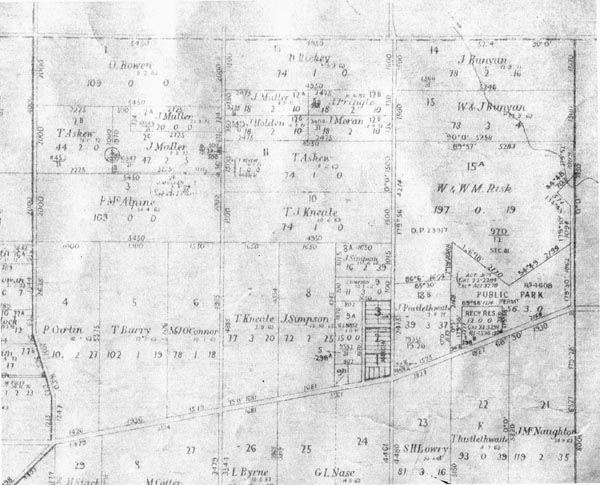
A map of the Smeaton district, prepared in March 1884, delineates the land subdivisions and owners. T. Askew is shown as the owner of two blocks of land to the north and northwest of the township of Ullina. The larger northern block is of 74 acres and the northwest block is of 44 acres. In addition, the map shows his ownership of a 1 acre allotment (presumably for a residence) facing the road and his 74 acre property, but within an "L-shaped" block of 42 acres owned by J. Muller. J. Muller is shown as the owner of another two blocks of land a little further to the north, one of 18 acres and one of 20 acres. To the east of J. Muller's 18 acre block, is another 18 acre block in the name of J. Pringle (believed to be James Pringle the father of Christian Pringle, who was married to Thomas Askew in 1854 (see below) . J. Postlethwaite, a friend of William Hudson from County Westmorland) is shown as owning land on the the eastern side of the townsite of Ullina, and adjoining land set aside for a Public Park and Recreation Reserve.
Land Holdings near Ullina, Parish of Smeaton
A portion of an 1884 map shows the location of the townsite of Ullina and the properties held by Thomas Askew, J. Muller, J. Pringle, J. Postlethwaite and others. The home of Mary Askew/Goddard/Sinclair, on a "Water Reserve", and the several properties of the Weatherson family are a few kilometres further north on Middle Creek.
(Photograph Ask-clu-001)
Marriage of Thomas Askew to Christian (also Christina and Christine) Pringle
The marriage of Thomas Askew (~1831-) and Christian Pringle (~1822-1887) was solemnised at the Wesleyan Chapel in Geelong on 20 July 1854. Thomas had been resident in Victoria for about two years and Christian for about one year. Information on the wedding certificate is as follows: Thomas Askew , bachelor age 24, born in Derbyshire, England. His profession is given as blacksmith and his address as South Geelong. Thomas Askew's parents are listed as Thomas Askew, blacksmith, and Elizabeth Askew. Christian Pringle is described as a spinster, born at Fifeshire, Scotland, age 27 years (and probably was closer to 33 years), whose occupation is listed as dressmaker, and her address given as Geelong. Her parents are given as James and Margaret Pringle, and her father's occupation is given as saddler. Witnesses were George and Augusta Hansen, and the celebrant was Richard Hart. Thomas Askew signed a declaration to the effect that he was a member of the Wesleyan Church.
No children from the married appear in the Victorian birth records.
Christian (also Christina and Christine) Pringle
Christian Corstorphine Pringle was the sixth child and second daughter of James Pringle and Margaret Flemingson of Kilrenny, Fife, Scotland (see footnote for a description of Kilrenny). Her parents were married on 5 Mar 1808 at Kilrenny, a fishing village and rural centre on the SE coast of the Fife Region, essentially the peninsular between the Firth of Tay and the Firth of Forth. All of their children were christened at Kilrenny, Fife, Scotland. Their names and baptism dates are:
James (05 May 1810), Elisabeth (28 Jun 1812), Anstruther (21 Aug 1814), Anstruther (17 Nov 1816), David (23 Jan 1819), Christian Corstorphine (20 Jan 1821), and Thomas (02 Apr 1823). The christening record for Christian Corstorphine Pringle contains the following information: Name Christian Corstorphine PRINGLE, Sex F, Christening 20 Jan 1821 at Kilreeny, Fife, Scotland. Parents James PRINGLE and Margaret FLEMINGSON.
Christian Pringle migrated to Australia on the sailing ship “Francis Ridley”, arriving at Port B in the Port Phillip District in July 1853. She travelled as an Unassisted Passenger, and is listed as follows in the Index of Inward Passenger Lists for British and Foreign Ports 1852-1889: PRINGLE Christina, age 31. It seems likely that she was actually 32 years old at the time of the voyage. Several other "Pringles" are listed as having migrated to Australia at about the same time, however I have not been able to establish definite links between these "Pringles" and Christian Pringle.
Following her marriage to Thomas Askew in 1854, her brother Anstruther Pringle (who had remained in Fifeshire, Scotland) and his wife Elizabeth Boyter/Pringle, had a daughter whom they named Christian Askew Pringle. She was born at Kilrenny, Fife on 10 October 1856.
Christian Corstorphine Pringle/Askew died at Ullina, Smeaton, Creswickshire, County Talbot, Victoria on 16 October 1887, and was buried at Smeaton Cemetery on 25 October 1887. She is listed as a “housewife” age 65 (unclear), and the cause of death given as “chronic bronchitis”. Her birthplace is given as Fifeshire, Scotland, her place of marriage to Thomas Askew is given as Geelong, at the age of 32 years (c.f. 27 on her marriage certificate), and prior to her death she had resided 34 years in Victoria. Her parents are listed as James Pringle “fisherman” (c.f. “saddler” on her wedding certificate) and Margaret Pringle, maiden name Fleming. Her husband Thomas Askew is listed as a farmer of Ullina, Smeaton. Christian and Thomas Askew had no children. Her Funeral Notice, published in the "Creswick and Clunes Advertiser" reads as follows: "The Friends of MR. THOMAS ASKEW, of Ullina, are Respectfully invited to follow the Remains of his late beloved WIFE to the place of interment, the Smeaton Cemetery. The Funeral will leave his residence, Ullina, at 2 p.m. on TUESDAY (tomorrow). CHARLES L. MORITZ, Undertaker, Clunes".
In July 2002, I wrote to Graeme Tapscott in Creswick, asking if he could establish where records were held for the Smeaton Cemetery. Graeme replied in early August that the Secretary of the Smeaton Cemetery had checked his records and found that “Thomas Askew is not in the Smeaton Cemetery, (but) Christina Askew is there in Plot No. 233, on the front row from the road opposite the gate”. Graeme said he would go to the cemetery and see if there was a headstone, but none has been located.
Whither Thomas Askew
I have not been able to establish what happened to Thomas Askew after his wife died. In July 2002, I wrote to Graeme Tapscott (a Hudson relative) of Creswick, asking if he could establish where records were held for the Smeaton Cemetery. Graeme replied in early August that the Secretary of the Smeaton Cemetery had examined the records and Thomas Askew is not recorded as having been buried in the Smeaton Cemetery.
Records pertaining to a Thomas Askew appear in the Creswick & Clunes Advertiser Newspaper data base from May 1859 to December 1865. Some of these may be relevant to Thomas Askew of Higham Derbyshire.
Move of Mary Askew/Goddard/Sinclair to the Smeaton District
In 1860, when her husband, James Goddard, died at the age of 37 years, Mary Askew/Goddard was left in a difficult situation with no husband and four children to support. Mary Jane Goddard was six years old, Elizabeth Goddard was about four, Anne Goddard was two and James Thomas Goddard was not yet one year old. In June of the same year, Anne Goddard also died. Her marriage to Richard Sinclair in 1861 produced a further two children, Robert Sinclair (07/08/1862- ?) and Catherine or Kate Sinclair (20/05/1867-30/06/1895).
It is probable that Thomas Askew played an important role in supporting his half-sister, Mary and her family during the the mid to late 1860s and may have influenced the relocation of Mary and her family from Geelong to the Smeaton farming district, probably in the early 1870s. Mary Askew/Goddard/Sinclair's daughter, Mary Jane Goddard, married William Hudson, of the nearby Lord Clyde District, in 1873, and her daughter Elizabeth Goddard married John Weatherson of nearby Middle Creek in 1874. It is even possible, that the marriage between William Hudson and Mary Jane Goddard, which took place on "Skelgill Farm", Ullina, was in fact at the home of Thomas and Christina Askew.
Footnote on the Scottish Villages associated with the Pringle Family
Anstruther
The picturesque fishing village of Anstruther gained its Royal Charter in 1587 and comprises Anstruther Easter & Wester, Cellardyke and Kilrenny. In its heyday, Anstruther was one of the busiest ports in the East Neuk and is steeped in history. Even with the general decline of the fishing industry, Anstruther remains an attraction because of the Scottish Fisheries Museum. The museum is housed in old domestic buildings and also in the 16th century lodgings used by the monks from Balmerino Abbey. James Pringle and Margaret Flemingson of Kilrenny, named their third child and, following his death, their fourth child Anstruther.
Kilreeny
Kilreeny is village at the eastern end of Anstruther, and was formerly known as Upper Kilrenny. A church was founded here in AD 864 by the Celtic Culdees, and the present parish church, whose square tower was known to fishermen as 'St Irnie', dates from the 15th century and was extended in 1808 and renovated in 1933. In the churchyard are to be found the Scott of Balcomie Mausoleum, the Beaton Burial Enclosure and Lumsdaine's Burial Enclosure. Innergellie House, a former home of the Beatons and part of the marriage dowry of King Robert III's wife Annabella Drummond, was rebuilt in a Baroque style in 1740. Nearby is the Skeith Stone which marks the spot where Danish invaders were once defeated by the men of Kilrenny and further up the coast are the Caiplie Caves which are associated with Iron Age settlement and with St Adrian and St Ethernan. A Conservation Area was established in Kilrenny in 1977. (From the Gazetteer for Scotland, 1995-2001).
Corstorphine
Corstorphine is a village and parish adjacent to Edinburgh. There is a mineral spring near the village of Corstorphine, from which weak, sulphureous water has been used for many years for medicinal and curative purposes by citizens from Edinburgh. Why the name Corstorphine was chosen as the second given name for Christian Pringle is not known.
Ann Askew (~1832-
The Mystery Solved
As stated in the above introduction, I was intrigued by the names of the witnesses at the wedding of James Goddard and Mary Askew in Geelong on 6 January1853 (Thomas Askew and Ann Siddall) and the name of the informant at the time of James Goddard's death in 1860 (George Culliford, stated to be the brother-in-law of James Goddard).
It seemed probable that Thomas Askew was Mary Askew's younger half brother, who accompanied her on the voyage to Australia on the "Sir Robert Sale", but I was unsure about Ann Siddall, and equally unsure about how George Culliford could be James Goddard's brother-in-law.
A search of births, deaths and marriages in Victoria for the period 1853-1860 revealed that two George Cullifords were married in 1853, the same year as James Goddard and Mary Askew were married. One of these marriages was between George Culliford and Ann Siddall and took place at Christ Church (C of E in Geelong). It seemed most likely that these were the parties mentioned on James Goddard’s death certificate and wedding certificate respectively.
The wedding certificate for George Culliford and Ann Siddall provided the information that the wedding took place on 21 June 1853, that both George Culliford and Ann Siddall were from the Christ Church Parish, that George was a bachelor and Ann was a widow, that the witnesses were Josh S Matters of Chilwell and ?Rebecca ?Faye of Ashby. The minister was John Potter. A number of possibilities were considered. Either:
-
Ann Siddall was the previously-married sister of Mary Askew ( Mary Askew had a younger half-sister named Ann, who would have been about 20 in 1853), or
-
Ann Siddall was the previously-married sister of James Goddard, or
-
Ann Siddall was the sister of James Goddard’s first wife (remembering James Goddard was listed as a “widower” at the time of his marriage to Mary Askew).
The problem was resolved by examining marriage records for Ann Askew of Derbyshire, and finding details of her marriage to William Siddall in mid 1852. Soon after the wedding, Ann and William Siddall left from Liverpool for Australia on the "Jas Carson". They arrived in Victoria in October 1852, in good time for the wedding of James Goddard and Mary Askew on 6 January 1853. William Siddall died a little over two months later on 13 March 1853. On 21 June 1853, at Christ Church, Geelong George Culliford married Ann Askew/Siddall, thereby making him James Goddard's brother-in-law.
Ann Askew's Life in Higham, Derbyshire
Ann Askew was the second child and first daughter of James and Elizabeth Askew. She was born in Higham about 1832, and was the younger sister of Thomas Askew, and younger half-sister of Mary Askew. Ann appears in the census returns for Higham of 7 June 1841 as a child of 9 years, but is absent from the Askew Household at the census of 30 March 1851, presumably having left home to work.
In the June Quarter of 1852, Ann Askew married William Siddall at Chesterfield, Derbyshire, a large town to the north of Higham. Matching entries for Ann Askew and William Siddall were located in the St. Catherine’s B,D&M records (Marriages Volume 7b, Page 807). Ann would have been 19 years old and William about 21 years.
An IGI record for the birth of William Siddall indicates he was born in 1831 at Hingham (sic); presumably Higham, Derby, England. This birth date is consistent with his age of 21 years, when he travelled on the" Jas. Carson" to Australia in 1852, and also confirms his age of 22 years, at the time of his death in Geelong in 1853.
Migration to Australia
Soon after their marriage, probably in July 1852, William Siddall and Ann Askew/Siddall boarded the "Jas Carson" at Liverpool, their intention being to meet up with Ann's brother Thomas and half-sister Mary in Geelong, Victoria. They disembarked at Port "B" in the Port Phillip district in October 1852. The shipping record gives Ann Askew/Siddall's age as 20 years, her occupation as Agricultural Labourer and her origin as English. William Siddall is described as 21 years, Labourer, and English.
The “Jas Carson”, sailed under Patrick Agnew (Master), was a vessel of 1189 tons, licenced to carry 392 passengers. It sailed from Liverpool with a passenger list comprising 358 adults (316 male, 42 female), 15 children (10 male, 5 female) and 3 female babies. Of the total of 376 souls, 198 were English, 144 were “Scotch”, 25 were Irish, and 9 Others.
On 6 January 1853, William and Ann Siddall attended the wedding of Ann's half-sister Mary Askew, at Christ Church, Geelong. Ann Siddall was named as one of the witnesses, the other being Thomas Askew, Mary Askew's half-brother.
Death of William Siddall
The death of a William Siddall occurred in Geelong in 1853, and he was buried in the Parish of Christ Church. Record CF 24676 of the Victorian Pioneers Index 1837-1888 for 1853 gives his name as William Siddall, states that his father and mother were unknown, and that he died at the age of 22 whilst resident at Ashby. His burial certificate gives the further information that he was was a Farmer, and that he died on 13 March 1853 and was buried on 14 March 1853. Ashby is the old suburb to the north of Chilwell, now known as Geelong West. The Geelong Cemetery Records have an entry for William Sidall, who was buried in the Church of England (older Area) of the Geelong Eastern Cemetery (Register No.110930). He died on 13/03/1853 and was buried on 14/03/1853.
Ann Askew/Siddall and George Culliford
Ann Askew/Siddall married George Culliford at Christ Church, Geelong on 21 June 1853, a little more than three months after the death of her husband William Siddall. She was described as a "widow", and he was described as a bachelor, both of the Parish of Christ Church. The minister was John Potter, and the witnesses Joseph S. Matters of Chilwell and Rebecca ?Faye of Ashby.
A search for "George Culliford" in the Indexes to Shipping Lists, for arrivals to the Port Phillip District within the period prior to and including 1853, produced one entry. A George Culliford was a passenger on the "Monteagle", arriving April 1853. The “Monteagle”, under James Lorby (Master), was a sailing ship of 999 tons, licensed to carry up to 427 passengers. It sailed from Deptford (Debtford), a dock and ship-building facility on the Thames, London, on 21 December 1852, and arrived in Melbourne on 12 April 1853. The Unassisted Passengers included a George Culliford age 32, an agricultural labourer, and a Hannah Culliford aged 34, both from Somerset, England. Both could read and write and gave C of E as their religious affiliation. They went ashore “on own account” to Melbourne. This George Culliford would have been born in about 1820.
I have searched the Victorian BD&M, but have not been able to locate any children from the marriage of George Culliford and Ann Askew/Siddall, nor do I have any details of their life in Australia after 1860. The Geelong Cemetery Records, however, do have an entry for a George James Culliford, who was buried at Geelong Western Public Cemetery (Register No. 2190). He died on 08/04/1876 at age 53 years and was buried on 11/04/1876. These data suggest that George James Culliford was born in about 1822.